Showing posts with label middle grade. Show all posts

Monday, 1 September 2014

Review - The Girl Who Fell Beneath Fairyland and Led the Revels There by Catherynne M. Valente


The Girl Who Fell Beneath Fairyland and Led the Revels There (Fairyland, #2)

Series: Fairyland #2
Published by Feiwel & Friends on Oct 2 2012
Genres: Fantasy, Middle Grade
Pages: 258
Rating: 5/5 stars
September has longed to return to Fairyland after her first adventure there. And when she finally does, she learns that its inhabitants have been losing their shadows—and their magic—to the world of Fairyland Below. This underworld has a new ruler: Halloween, the Hollow Queen, who is September’s shadow. And Halloween does not want to give Fairyland’s shadows back. 
Fans of Valente’s bestselling, first Fairyland book will revel in the lush setting, characters, and language of September’s journey, all brought to life by fine artist Ana Juan. Readers will also welcome back good friends Ell, the Wyverary, and the boy Saturday. But in Fairyland Below, even the best of friends aren’t always what they seem. . . 
I never for a second doubted that I would love The Girl Who Fell Beneath Fairyland…. There wasn’t a thing not to love. After the phenomenal first book in the series, I was thoroughly hooked. In fact, I even managed to read the second book within a year of reading the first, which is quite a feat for me!

The Girl Who Fell Beneath Fairyland and Led the Revels There takes place a year after September returns to her home in Omaha, Nebraska. She itches to return to Fairyland, and searches for the Green Wind and opportunities to go back anywhere she can. She finally returns to Fairyland on her thirteenth birthday whilst attempting to read French books in a corn field. September arrives in Fairyland hoping to find adventure and excitement, though she doesn’t anticipate how needed she is. She is quickly thrust into the current upheaval faced by the residents of Fairyland – they are losing their shadows, and with their shadows their magic. September discovers that her own shadow, which she bargained away during her first visit to Fairyland, is the force behind the mass shadow exodus and takes it upon herself to stop Halloween (as September’s shadow has dubbed herself).

Like the first book in the series, this novel was incredibly creative. I envy Valente her ginormous imagination, but I’m so grateful to be able to read about all of these fantastical characters and events even if I am incapable of creating anything quite so magical myself. I was particularly enamoured with the tea and coffee family (whose names I unfortunately cannot remember!) and Aubergine the Night Dodo, who was absolutely lovely, though I’ll admit that every single character in this series is utterly unforgettable.

I was also impressed with the integration of September’s personal growth. She’s truly growing up, and you can see her maturing right before your eyes. Where she was a heartless child in The Girl Who Circumnavigated Fairyland… she has begun to develop a heart and a conscious. She is no longer a child and it is evident in the choices she makes as well as the way that she is dealt with in the narration. There is a more melancholy streak in this book that in the first, and I think that is due to the fact that September is indeed becoming a teenager and is able to see the darkness through all of the beauty and brilliance of Fairyland. The inclusion of her father at the end of the book ripped my heart right out of my chest.

The sporatic illustrations throughout the book were beautiful and imaginative. I loved the way that the illustrator played with proportions and didn’t necessarily create images that directly translated exactly what was written. It really added to the reading experience.


My one source of confusion or annoyance in The Girl Who Fell Beneath Fairyland… was that September’s shadow had her own name and her own identity, yet all of the other shadows went by their person’s name. For instance, Saturday’s shadow was called Saturday. I understood why this made sense for narrative purposes, as it illustrated the fact that they were two sides of the same person, but I thought it rather odd that Halloween was the one exception. Other than that, I was completely enraptured by this book and would recommend it to anyone regardless of age or gender or anything else. It’s the kind of book that makes me really appreciate what middle grade books have to offer and why they are so important. 

Friday, 8 August 2014

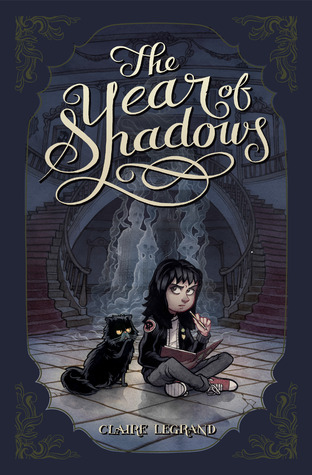
Review - The Year of Shadows by Claire Legrand


The Year of Shadows

The Year of Shadows by Claire Legrand
Series: Standalone
Published by Simon & Schuster on August 27 2013
Genres: Middle Grade, Paranormal
Pages: 416
Rating: 4/5 stars
Olivia wants a new life, and it might take ghosts to get it. A heartfelt, gently Gothic novel from Claire Legrand. 
Olivia Stellatella is having a rough year. 
Her mother's left; her neglectful father, the maestro of a failing orchestra, has moved her and her grandmother into the city's dark, broken-down concert hall to save money, and her only friend is Igor, an ornery stray cat. 
Just when she thinks life couldn't get any weirder, she meets four ghosts who haunt the hall. They need Olivia's help; if the hall is torn down, they'll be stuck as ghosts forever, never able to move on. 
Olivia has to do the impossible for her shadowy new friends: save the concert hall. But helping the dead has powerful consequences for the living; and soon it's not just the concert hall that needs saving.

Olivia Stellatella is prickly. She’s stubborn and hurt and sometimes mean, and altogether a difficult twelve-year-old girl. Which makes complete sense, considering her mother left, her father walks around in a musical haze, her grandmother is a bit dotty and not in the greatest of health, and her family has absolutely no money to speak of. Not to mention the fact that she now lives in the rehearsal space of the old concert hall in which her father, an orchestra conductor, works. Someone mentioned that Olivia reminded them of Winona Ryder as Lydia Deetz in Beetlejuice, which I agree with 100%. Olivia is a lot like a younger Lydia, which was as entertaining as you might expect.

Yes, it’s safe to say that Olivia isn’t the most pleasant person to be around. Thankfully, despite her best efforts to the contrary, she manages to snag a host of new friends throughout her year of living in Emerson Hall – Henry, a boy who gets straight As and spends all of his free time roaming the hall; Igor, a grumpy black cat whom Olivia imagines speaks like Cary Grant; Joan, a friendless girl who likes to spend her spare time protesting and talking about solidarity; and four ghosts stuck haunting Emerson Hall until they recover whatever object that is holding them in place and right it.

I honestly can’t think of another word to describe this book other than sweet. It’s not as light as a lot of middle grade books I’ve read, which is something I really appreciated. Olivia’s problems are real problems, and the fact that she’s twelve years old doesn’t negate them. This book really tugged at my heartstrings and made me feel for the characters (even the Maestro!). One smaller aspect of the book that I liked and thought was special was the way that Olivia repeatedly referred to The Economy to explain her predicament. It was clear that it was a term she’d picked up from the adults around her and that she wasn’t entirely certain of what it meant, only that it was to blame for the failure of the orchestra. I feel like many people throw around the term The Economy in a very similar manner – not quite sure what they’re talking about all the time, but thinking that it makes them sound knowledgeable. It was a minor detail, but one that I appreciated.

The ghosts are another notable feature in this book - they are all so interesting and unique. Their backstories are all absolutely heartbreaking (especially Mr. Worthington!) and I thought that the way that Olivia and her friends were able to help them was very creative. I loved being able to glimpse short snippets of their lives, and seeing them move on was bittersweet.


I can’t say that I’d recommend this to everybody, but I’d definitely pass it around to anyone who likes middle grade books or books about ghosts. It gets pretty dark at times, so that’s something to consider. I know that a lot of people who read middle grade like it because it tends to be a bit lighter and fluffier than some of the other options out there. This is not the book for you if that’s what you’re looking for.

Friday, 9 August 2013

Review - Wildwood by Colin Meloy


Wildwood (Wildwood Chronicles, #1)

Wildwood by Colin Meloy (Illustrations by Carson Ellis)
Series: Wildwood Chronicles #1
Published by Balzer + Bray on August 30 2011
Genres: Fantasy, Middle Grade
Pages: 541
Rating: 3/5 stars

The first book in the epic middle-grade fantasy series full of magic, wonder, and danger—nothing less than an American Narnia—from Colin Meloy, lead singer of the highly celebrated band the Decemberists, and Carson Ellis, the acclaimed illustrator of the New York Times bestselling The Mysterious Benedict Society.


I picked up Wildwood at the bookstore based solely on it’s adorable, eye-catching cover. I don’t read a lot of middle grade books, but I tend to really enjoy the ones I do read. I had high hopes for Wildwood, though when I checked it out on GR I found it had quite a few not-so-flattering reviews. I tried not to let other people’s reviews of Wildwood influence my own reading of it or ruin any enjoyment I might get out of it, as I do with every book I read reviews of.

There were some incredibly valid points made in those reviews though, primarily regarding Prue’s parents. They saddle twelve-year-old Prue with a lot of responsibility for her baby brother, Mac. It’s kind of unbelievable to me that they would send Prue out on her bike, a metal wagon attached to it carrying Mac (as opposed to an actual bike trailer in which he would be safe), for the ENTIRE DAY. They literally do not see Mac after they send him and Prue out in the morning. I understand why Meloy chose to make Prue’s parents so hapless – it was a way of giving Prue the freedom to have her adventure without dealing with parental restrictions, or killing the parents off entirely as many children’s books do – but it just didn’t work. When you learn later in the book just how badly the couple wanted children, it makes no sense that they would pretty much abandon them to their own devices.

That brings me to another annoyance I had with Wildwood, also regarding Prue’s parents. The deal that they made with Alexandra makes absolutely no sense. They were just SO STUPID. Of course you are going to have to repay the creepy witch who fulfills your deepest desire! Are you brain dead? I was also kind of offended at their apparently resigning themselves to childlessness without exhausting all of their options. It really bothers me that people who say that they are desperate for children and that they need children to be a ‘real’ family are unwilling to consider adoption, fostering, or even surrogacy! There are so many ways around infertility if you want it badly enough. I will never understand the obsession people have with having ‘their own’ biological children.

As other reviewers have brought up, there are many Narnia parallels in Wildwood. I actually found it a little bit too derivative in some parts. Not only is Wildwood, like Narnia, a world hidden within the real world that features talking animals, it also uses the whole evil witch queen trope, which I HATE. Curtis’ plot is quite similar to Edmund’s in The Lion, the Witch, and the Wardrobe in that he is taken in by the villainous woman and instinctively trusts her, much to the peril of everyone around him. I actually sympathized with Alexandra/the Dowager Governess to a certain degree. Her life took a huge nose-dive and she made some crappy decisions but I really don’t think she deserved to get exiled for trying to get her son back, though her methods of doing so were a little bit… uncouth. The evil witch trope reeks of misogyny. Of course women in power become corrupt and go crazy… Apart from the whole sacrificing-Mac-to-the-ivy-and-causing-the-destruction-of-her-entire-world, I didn’t hate her. I thought that her attitude toward the coyotes and “civilizing” them was a really neat parallel to colonialism in the real world.

I feel like I’ve spent so much of this review complaining, but I really did like the book! I thought the characters were fun and interesting. They made both good and bad decisions and for the most part I found that Prue and Curtis both acted appropriately for their age, which was nice. Prue is a bit belligerent, but I think it makes sense in terms of what she went through and the way she was raised. I was a little bit off-put by Curtis toward the end of the book. I didn’t understand why he was so close to going home when he passed the bush where he was captured by the coyotes on the march to the Ancient Grove, but the not much later he made the decision not to go home with Prue. He chose to stay with the bandits (I would, too, they’re awesome and I want to marry Brendan), letting his parents believe that he’s dead. Not cool, Curtis. My favourite character by far was Brendan. He’s exactly the kind of anarchic leader I like to see – he’s modest, friendly, talented/skilful, intelligent, funny… Sigh. I liked Iphegenia as well, though that may be partially due to her awesome name.

I do wish that it had been a few hundred pages shorter. It was a tad long-winded at times and some of the nature descriptions were a little bit too self-indulgent and overblown, but for the most part the pacing was decent. It was a bit slow to start, between the inciting incident (Mac’s kidnapping) and Prue taking action to go find him. I think it would have been better suited to being around 300-350 pages as opposed to its 541 pages, but I think young me would have appreciated its’ length. I was really into long books when I was a kid – they kept me going longer!