Showing posts with label historical fiction. Show all posts

Friday, 26 September 2014

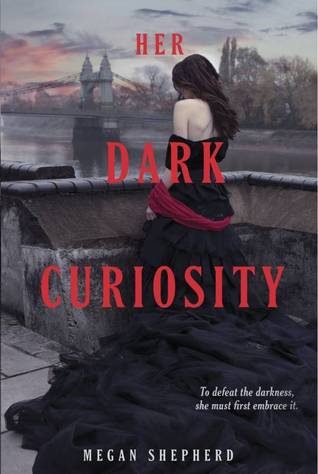
Review - Her Dark Curiosity by Megan Shepherd


Her Dark Curiosity (The Madman's Daughter, #2)

Her Dark Curiosity by Megan Shepherd
Series: The Madman’s Daughter #2
Published by Balzer + Bray on January 28 2014
Genres: horror, historical fiction, young adult
Pages: 420
Rating: 3/5 stars
To defeat the darkness, she must first embrace it. 
Months have passed since Juliet Moreau returned to civilization after escaping her father's island—and the secrets she left behind. Now, back in London once more, she is rebuilding the life she once knew and trying to forget Dr. Moreau’s horrific legacy—though someone, or something, hasn’t forgotten her. 
As people close to Juliet fall victim one by one to a murderer who leaves a macabre calling card of three clawlike slashes, Juliet fears one of her father’s creations may have also escaped the island. She is determined to find the killer before Scotland Yard does, though it means awakening sides of herself she had thought long banished, and facing loves from her past she never expected to see again. 
As Juliet strives to stop a killer while searching for a serum to cure her own worsening illness, she finds herself once more in the midst of a world of scandal and danger. Her heart torn in two, past bubbling to the surface, life threatened by an obsessive killer—Juliet will be lucky to escape alive. 
With inspiration from Robert Louis Stevenson’s The Strange Case of Dr. Jekyll and Mr. Hyde, this is a tantalizing mystery about the hidden natures of those we love and how far we’ll go to save them from themselves.
I probably shouldn’t have read this book.

I was drawn in by the near-pristine beauty of it at the library – I don’t often encounter library books that look brand new, and I was tricked by the prettiness. It’s too bad that the actual content of these books isn’t as great as their gorgeous covers.

I had high hopes for Her Dark Curiosity, though I’m not entirely sure why. I didn’t particularly enjoy The Madman’s Daughter, for a variety of reasons.  Namely, Juliet’s idiocy and the completely unnecessary love triangle. But I thought, maybe book two will be better. Maybe Juliet will start to use her brain and stop whining all the time and kick those stupid miserable boys to the curb. Also, I was under the (incorrect) assumption that 1/3 of said love triangle was dead, because I’m an idiot who indulges in wishful thinking.

But oh no. None of my hopes were answered by this book. I was delighted to find that this book was supposed to be loosely based on/inspired by The Strange Case of Dr. Jekyll and Mr. Hyde. I’m a big fan. Unfortunately, they really meant loosely. There are a few elements of Jekyll and Hyde present, but it’s minimal. The reintroduction of the love interest who isn’t Montgomery (I want to say his name is William or Edward, because everyone in Victorian London was called William or Edward) wasn’t much of a shocker, and I honestly don’t think it even merits a spoiler tag. Let me know if you disagree, but it was pretty obvious, though I tried to convince myself otherwise in case sheer willpower prevented it from happening. Sigh. The love triangle really gets amped up in this book. Compared to Her Dark Curiosity, it is merely a slight annoyance in The Madman’s Daughter. There is just so much drama between Juliet and Montgomery and William-Edward and I don’t understand it at all because they’re both absolute dickheads! I’ll pass, thank you.

The ‘plot’ of Her Dark Curiosity is surprisingly sparse. I honestly don’t remember much of the plot that didn’t revolve around a) the love triangle, b) Juliet’s angst over her condition/finding a remedy, or c) further angst over William-Edward’s escalating murderous split personality disorder. I think the main problem I have with sympathizing with these plights is that I just completely disagree with everything that Juliet stands for. If I were in her shoes, William-Edward would be properly dead by now (and I would have zero desire to bring him back to life Frankenstein-style, thank you very much!). Oh! I remembered one other plot-y thing – Juliet discovers that she’s caught up in a big ol’ conspiracy and then (SPOILER) kills a bunch of people using electricity and lab creatures. She also scars her best (well, only) friend for life in the process, but who needs friends when you have Montgomery and William-Edward, right??

Given the nature of this review, it might be surprising that I gave this book three stars. I actually did enjoy certain parts of the book. I’m a big fan of Shepherd’s writing style. It is very descriptive without turning purple, and I think she really succeeds in creating a neo-Gothic novel, in style if not in form. I also really love Juliet’s dark side. She doesn’t let it out as often as I’d like, but I think that the fact that she has a serious violent streak is wonderful. I think that she could be a truly remarkable character if she just toned down the altruism a little bit. She reminds me a bit of Allie from Julie Kagawa’s Blood of Eden trilogy in that sense. She has the potential to be a total badass, but she is just too nice.


Considering how much grief this series has caused me, you’d think I’d back out and abstain from the likely torment of A Cold Legacy, but you would be wrong. I’ve already invested enough time in this series that I might as well see it through, right? Besides, maybe Frankenstein William-Edward will be less angsty than the current version. On a side note: how many times can this dude be killed off? WHY DON’T YOU JUST TAKE THE HINT AND STAY DEAD? NOBODY LIKES YOU. I am interested to see the setting shift once again, this time from urban London to the Scottish countryside. I think that setting is definitely one of Shepherd’s strong suits.

Friday, 12 September 2014

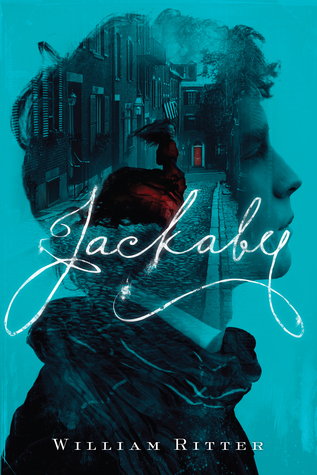
Review - Jackaby by William Ritter


Jackaby

Jackaby by William Ritter
Series: Standalone
Published by Algonquin Young Readers on September 16 2014
Genres: paranormal, historical fiction, young adult
Pages: 304
Rating: 3 stars
Newly arrived in New Fiddleham, New England, 1892, and in need of a job, Abigail Rook meets R. F. Jackaby, an investigator of the unexplained with a keen eye for the extraordinary--including the ability to see supernatural beings. Abigail has a gift for noticing ordinary but important details, which makes her perfect for the position of Jackaby’s assistant. On her first day, Abigail finds herself in the midst of a thrilling case: A serial killer is on the loose. The police are convinced it’s an ordinary villain, but Jackaby is certain it’s a nonhuman creature, whose existence the police--with the exception of a handsome young detective named Charlie Cane--deny. 
Doctor Who meets Sherlock in William Ritter’s debut novel, which features a detective of the paranormal as seen through the eyes of his adventurous and intelligent assistant in a tale brimming with cheeky humor and a dose of the macabre. 
As you probably know, Jackaby has been described as a cross between Sherlock and Doctor Who. Unlike most people, I was somewhat wary of this comparison. Don’t get me wrong, I like Doctor Who and I’ve seen the first two seasons of BBC’s Sherlock (though Elementary is superior in every possible way). The problem that these two shows share is that they are both led by the same misogynistic pig of a showrunner: Steven Moffat. This guy is an absolute tool. He’s responsible for running Doctor Who right into the ground, and he’s a self-congratulating, arrogant, pompous jerk-off. Clearly this is something I feel strongly about.

So! Coming back to Jackaby – I was interested to see how Ritter would put his own spin on the commonalities between Sherlock and Doctor Who and whether he would manage to allay some of the more offensive aspects of the two shows he is clearly pulling inspiration from. And yes I know that both Sherlock (the original stories and the franchise) and Doctor Who existed long before Moffat came around, but upon reading this book it is obvious that BBC Sherlock and Moffat’s era of DW are Ritter’s primary inspirations.

Thankfully, Jackaby is a pretty woman-friendly novel. It didn’t strike me as particularly offensive in any way, which I am grateful for. However, I did find it lacking in a few other ways. Though the main character, Abigail, has her interesting points, I felt that she lacked in depth. She is very trusting of the people around her – she is a young woman all alone on an unfamiliar continent in the late Victorian period and she struck me as incredibly naïve and accepting. Rather than doing any planning, Abigail whirled from event to event without any real agency. The only times she showed any backbone were when she ineffectually threw books at the villain and when she argued with Jackaby at the end of the book. For the most part, she just went with whatever was going on around her without much question. I found her almost instant acceptance and trust in Jackaby very unrealistic. I find it hard to believe that a woman in her position would be so unguarded.

I also found Jackaby trying as a character. He was incredibly inconsistent. It was as though Ritter was attempting to combine Sherlock Holmes and the Doctor into the same character, but it failed completely. His eccentric nature was irritating rather than endearing, and he constantly bounded between the positivity of the Doctor and the misanthropy of Sherlock. It was exhausted and simply didn’t make sense.

The three other principle characters – Charlie Cane, Jenny, and Detective Marlowe – are very hollow. We know very little about any of them beyond their surface characteristics. The semi-romance between Charlie and Abigail is very stilted and hard to support. I have no idea what exactly Abigail liked about Charlie, and vice versa.

Finally, the supernatural elements lacked finesse. The mystery was incredibly obvious (I figured out who the villain was the first time he was introduced) and the mythology just wasn’t that interesting. I did like how magical creatures were everywhere, but I wish there was an explanation for why Jackaby happened to be able to see what no one else could. It struck me as all too convenient that only one person in the entire world had the ability to witness the paranormal creatures of the world.


Though I enjoyed reading this book and didn’t find it grossly appalling, I find that a closer examination is poking holes all over the text and exposing more and more things that just didn’t add up for me. I wouldn’t tell anyone not to read this, but I don’t think I’d purchase it either. It just wasn’t as good as it could have been, and I found it rather disappointing as a whole.

Friday, 22 August 2014

Review - The Girl You Left Behind by Jojo Moyes


The Girl You Left Behind: A Novel

The Girl You Left Behind by Jojo Moyes
Series: Standalone
Published by Penguin Books on June 24 2014
Genres: Historical Fiction, Contemporary, Adult Fiction
Pages: 464
Rating: 3/5 stars
Another New York Times bestseller by the author of Me Before You—a spellbinding story of two women united in their fight for what they love most 
Jojo Moyes’s word-of-mouth bestseller, Me Before You, catapulted her to wide critical acclaim and struck a chord with a wide range of readers everywhere. Now, with The Girl You Left Behind, Moyes returns with another irresistible heartbreaker—a breathtaking story of love, loss, and sacrifice told with her signature ability to capture our hearts. 
Paris, 1916. Sophie Lefèvre must keep her family safe while her adored husband, Édouard, fights at the front. When their town falls to the Germans in the midst of World War I, Sophie is forced to serve them every evening at her hotel. From the moment the new Kommandant sets eyes on Sophie’s portrait—painted by her artist husband—a dangerous obsession is born, one that will lead Sophie to make a dark and terrible decision. Almost a century later, Sophie’s portrait hangs in the home of Liv Halston, a wedding gift from her young husband before his sudden death. After a chance encounter reveals the portrait’s true worth, a battle begins over its troubled history and Liv’s world is turned upside all over again.
The Girl You Left Behind is a book I normally wouldn’t gravitate towards. I picked it up because it was the only book in the ferry gift shop that looked decent, and I was desperate for a book (I’d finished the book I brought in the car & my e-reader was dead!). I’ve heard a lot of praise for Jojo Moyes’ books and thought I’d give this one a shot.

I must say right off the bat that I just didn’t love this book. Maybe it was the fact that I didn’t realise when I started that the majority of the book was devoted to the contemporary story line. I just didn’t connect with Liv and I wish the entire book had just been Sophie’s story. I loved the glimpse into life in a small French village under German occupation during WWI. It was fascinating. How could I possibly not love Sophie after that pig scene at the very beginning of the book? She was clever and stubborn and independent.

I found Liv rather unsympathetic. I understood that she was in a poor state of mind following her husband’s death, but I just thought she was whiny and irritating. She has come to be the owner of a very special painting (the connection between her story and Sophie’s) bought by her and her late husband on their honeymoon. This painting becomes part of a restitution case, as descendants of Edouard LeFevre (Sophie’s husband) claim that it was stolen during the war and demand its return to its rightful owners. Liv doesn’t want to return the painting because of the emotional attachment that she has to it, and she also suspects that the family is pursuing the painting for all the wrong reasons. I agree that the LeFevres were assholes, but I don’t think that what Liv did was much better. She was holding onto the painting the same way that she was holding on to every little thing that reminded her of David – it was holding her back from any kind of future she could imagine.


The main issue I had with the modern day storyline was that there was so much emphasis on the romance between Liv and Paul. I just didn’t see the chemistry at all. I didn’t care about them. I didn’t really care about what happened to in the restitution case. The only person who I felt actually deserved that painting was Sophie, but she was long dead by that point. I think that this book would have been much more successful if Sophie’s story took up the majority of the bulk, while Liv’s romance and legal case took a backseat. 

Friday, 1 August 2014

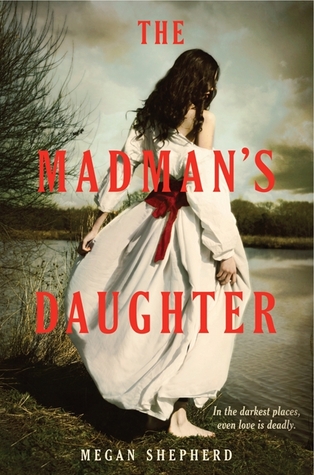
Review - The Madman's Daughter by Megan Shepherd


The Madman's Daughter (The Madman's Daughter, #1)

The Madman’s Daughter by Megan Shepherd
Series: The Madman’s Daughter #1
Published by Balzer + Bray on January 29 2013
Genres: Young Adult, Mystery, Horror, Paranormal, Historical Fiction
Pages: 420
Rating: 3/5 stars
Sixteen-year-old Juliet Moreau has built a life for herself in London—working as a maid, attending church on Sundays, and trying not to think about the scandal that ruined her life. After all, no one ever proved the rumors about her father's gruesome experiments. But when she learns he is alive and continuing his work on a remote tropical island, she is determined to find out if the accusations are true. 
Accompanied by her father's handsome young assistant, Montgomery, and an enigmatic castaway, Edward—both of whom she is deeply drawn to—Juliet travels to the island, only to discover the depths of her father's madness: He has experimented on animals so that they resemble, speak, and behave as humans. And worse, one of the creatures has turned violent and is killing the island's inhabitants. Torn between horror and scientific curiosity, Juliet knows she must end her father's dangerous experiments and escape her jungle prison before it's too late. Yet as the island falls into chaos, she discovers the extent of her father's genius—and madness—in her own blood. 
Inspired by H. G. Wells's classic The Island of Dr. Moreau, The Madman's Daughter is a dark and breathless Gothic thriller about the secrets we'll do anything to know and the truths we'll go to any lengths to protect.
I really enjoyed the beginning of this book. It really hooked me in and I thought that the Juliet we meet in London was a fascinating character – she was smart and different and a little macabre, and I liked that. However, things took a turn for the worst when we were introduced to Love Interest #1, Montgomery. Suddenly a cruel scientist was trying to rape Juliet and she was cutting him with a cleaning tool and then off we go on a ship heading towards Australia. We meet Love Interest #2, Edward, on said ship and things just start to get simultaneously weird and boring, which is quite a feat in and of itself. This whole section of the book was just very rushed and disjointed.

By the time we hit the halfway point, I was thoroughly unimpressed by Juliet. I loved that she had a dark side, but she was very angst-y about it. She wanted to be absolutely nothing like her father, which for some reason meant that she couldn’t be interested in science. It didn’t really make sense to me, especially the explanation given towards the end of the book for her stranger inclinations. I like characters who embrace that darker edge to them. I also really wanted Juliet to make up her mind about where she stood regarding the ‘monsters’. Were they beasts or humans? Was killing them considered murder or not? How could she pick and choose which ones were more human than the others and apply her human morality only to those select few? I know I worded that very strangely, but I’m not sure how else to phrase it. Her attachment to Balthazar and the snakey guy pissed me off because the way I see it, if you accept one or two, you have to accept them all.

Juliet spent a vast amount of time worrying about which boy she most wanted to kiss, when she clearly had much bigger problems on her hands – namely the monster roaming the island killing people. No big deal though, right? My main problem was that the love interests were so freaking boring. I honestly didn’t find myself rooting for either of them, though I disliked Edward more than Montgomery. I suppose that makes me Team Montgomery? No thank you. Team Get-Juliet-The-Hell-Away-From-These-Psychos is more my speed. For the most part, the characters (with the exception of Dr. Moreau) are all very modern, with 21st century ideas and beliefs, which didn’t cohere well with the Victorian setting. I had some qualms with the chosen time period, as it didn’t seem to add much to the book. Due to the vast majority of the book taking place on a more or less deserted island, the Victorian element doesn’t really come into play much and it felt a bit wasted.

The only characters I actually liked were the maid and the experiment-man gone rogue. They were cool and interesting, though by the end of the book one of them was dead and the other couldn’t speak.


Having not read The Island of Doctor Moreau, upon which this book is based, I only vaguely knew what was going to happen (most of the time). I knew the general idea, but nothing beyond that. That said, there was at least one thing that really worked for me in The Madman’s Daughter, and that was the atmosphere. This book had some seriously creepy moments, and despite the major issues I had with it, I sped through it. I thought the writing was solid, and am interested to see what else Megan Shepherd can produce in the years to come. Though I saw the twists coming miles away (this from someone who doesn’t usually pick up on these things!), I think I’ll give Book Two a chance. We’ll see. Hopefully that one will be more gothic horror story and less YA love triangle.

Wednesday, 21 May 2014

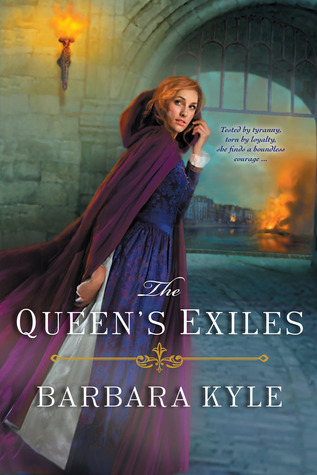
ARC Review - The Queen's Exiles by Barbara Kyle


The Queen's Exiles

The Queen’s Exiles by Barbara Kyle
Series: Thornleigh #6
Published by Kensington on May 27 2014
Genres: Historical Fiction
Pages: 352
Rating: DNF at 42%

1572. Europe is in turmoil. In the Netherlands the streets are red with the blood of those who dare to oppose the brutal Spanish occupation. A vengeful faction of exiled English Catholics is plotting to overthrow Queen Elizabeth and install her cousin Mary, Queen of Scots on the throne. But amid the unrest, one resourceful young woman has made a lucrative enterprise ... 
Scottish-born Fenella Doorn rules like a queen over a privateer's haven on the Isle of Sark. Her success at salvaging crippled vessels affords her gold and security, and it is on one of these ships that she meets wealthy Baron—and privateer—Adam Thornleigh. Secretly drawn to him, Fenella can’t refuse when Adam enlists her to join him in war-torn Brussels to help find his traitorous wife, Frances—and the children she’s taken from him.  
But Fenella’s own bold actions have put a price on her head. Now Adam and Fenella’s lives are in peril as they race across Europe in an attempt to rescue his young ones, defend the crown, and restore the peace that few can remember.

I received this book for free from the Publisher in exchange for an honest review. This does not affect my opinion of the book or the content of my review.

I tried really hard to like this book. It didn’t particularly offend my sensibilities in any way – the characters were decent, though I thought that it would have benefited from tightening up the number of characters it followed. I think it may have worked better for me if it only focused on Fenella and Adam, rather than Fenella, Adam, Isobel, Carlos, Frances, etc. I found myself dreading picking it up again, not sure which character I’d be following next, or whether I’d want to follow them at all. The only characters I truly cared about were Fenella and Adam, so it felt silly to me to feature the rest so heavily.


My biggest complaint is that the pacing was dreadful. It never really felt like anything was happening, and even when they did I found there to be a lack of urgency in the writing. I never feared for the characters, despite the frightening and risky situations they put themselves in. This was what really determined whether or not I would continue reading this book. If it were based merely on the characters and the plot, I feel like I would have greatly enjoyed The Queen’s Exiles. Unfortunately the writing made me nod off after about fifteen or twenty minutes of reading, whether I was tired or not. In my opinion, that is a sign that a book is just not meant for me.

Thursday, 8 May 2014

Review - Belle Epoque by Elizabeth Ross


Belle Epoque

Belle Epoque by Elizabeth Ross
Series: Standalone
Published by Delacorte Books for Young Readers on June 11 2013
Genres: Young Adult, Historical Fiction
Pages: 336
Rating: 3/5 stars
When Maude Pichon runs away from provincial Brittany to Paris, her romantic dreams vanish as quickly as her savings. Desperate for work, she answers an unusual ad. The Durandeau Agency provides its clients with a unique service—the beauty foil. Hire a plain friend and become instantly more attractive.  
Monsieur Durandeau has made a fortune from wealthy socialites, and when the Countess Dubern needs a companion for her headstrong daughter, Isabelle, Maude is deemed the perfect foil. 
But Isabelle has no idea her new "friend" is the hired help, and Maude's very existence among the aristocracy hinges on her keeping the truth a secret. Yet the more she learns about Isabelle, the more her loyalty is tested. And the longer her deception continues, the more she has to lose.

These characters weren’t exactly likeable, but they were interesting. I didn’t much enjoy being inside Maude’s head. She didn’t have a very memorable voice and despite the fascinating premise I found it kind of difficult to get into. The secondary characters were much more intriguing, particularly Isabelle. I could have done with a bit more development all around, though. Unfortunately, I ended the book feeling like I didn’t really know any of these people at all. I was particularly disappointed in the love interest, Paul. He was pretty boring, and I didn’t appreciate his jumping to conclusions.

The plot was certainly original. I enjoyed that aspect of it. I have a hard time enjoying books that involve lying and double lives because I spend so much time in anticipation of the moment when it all falls apart. It really fell apart for Maude. I just have a hard time sympathizing with liars, no matter how many good reasons they may have for doing so. Also it makes me really uncomfortable, as did the concept of repoussoirs. It was made to fail. It did feel good to read about how Maude and the other girls brought Durandeau down.

My favourite character in this book was Paris. The descriptions were delightful, though sometimes a tad overbearing. I do think that this book would have benefited from being written in third person rather than first. I’m not usually a big fan of third person, but I think it really would have worked here. Alas, it is what it is! The pacing was decent, if a little bit slow.