Showing posts with label dystopian. Show all posts

Friday, 19 September 2014

Review - The Queen of the Tearling by Erika Johansen


The Queen of the Tearling (The Queen of the Tearling, #1)
The Queen of the Tearling by Erika Johansen
Series: The Queen of the Tearling #1
Published by Harper on July 8 2014
Genres: Dystopian, Fantasy, Young Adult
Pages: 448
Rating: 2.5/5 stars
On her nineteenth birthday, Princess Kelsea Raleigh Glynn, raised in exile, sets out on a perilous journey back to the castle of her birth to ascend her rightful throne. Plain and serious, a girl who loves books and learning, Kelsea bears little resemblance to her mother, the vain and frivolous Queen Elyssa. But though she may be inexperienced and sheltered, Kelsea is not defenseless: Around her neck hangs the Tearling sapphire, a jewel of immense magical power; and accompanying her is the Queen’s Guard, a cadre of brave knights led by the enigmatic and dedicated Lazarus. Kelsea will need them all to survive a cabal of enemies who will use every weapon—from crimson-caped assassins to the darkest blood magic—to prevent her from wearing the crown. 
Despite her royal blood, Kelsea feels like nothing so much as an insecure girl, a child called upon to lead a people and a kingdom about which she knows almost nothing. But what she discovers in the capital will change everything, confronting her with horrors she never imagined. An act of singular daring will throw Kelsea’s kingdom into tumult, unleashing the vengeance of the tyrannical ruler of neighboring Mortmesne: the Red Queen, a sorceress possessed of the darkest magic. Now Kelsea will begin to discover whom among the servants, aristocracy, and her own guard she can trust.
I’m glad to say that I didn’t hate this book as much as most of my fellow bloggers seem to, but it definitely wasn’t what it was pitched to be. I was lucky enough to know going into it that it wasn’t a straight-up fantasy, but a strange dystopian fantasy hybrid in which an event called The Crossing occurred, during which most modern “luxuries” a la medicine and electricity were lost. Now, what exactly the Crossing was is never explained in the nearly 500 pages of this book. I imagine it may be explained in subsequent books, but it was kind of a mind fuck.

There is some serious logic fail going on in this book. There is talk of other nations being capable of plastic surgery yet the Tearling doesn’t even have the most basic medicine. They don’t even have printing presses. It’s your basic quasi-medieval fantasy setting with a big ol’ FUCK YOU twist thrown in for good measure. And it doesn’t really work. The Queen of the Tearling would have been a thousand times more enjoyable if it wasn’t such a weird setting.
 kidding me
The characters leave a lot to be desired as well. Kelsea, the main character and incumbent Queen of the Tearling, is rash and impulsive. She doesn’t think things through, which is a terrible trait in a Queen. She talks about wanting to do the best for her kingdom, yet she doesn’t actually consider the consequences of her actions. For instance, when she learns about the crown-condoned slave trade between the Tearling and neighbouring kingdom Mortmesne, she immediately releases all of the prisoners, hires a bunch of them on as her personal staff, and burns the cages used to transport them. She doesn’t care that the Queen of Mortmesne is infinitely more powerful than she is and that she will be slightly insulted to discover her shipment of slaves has not been delivered. I agree that something had to be done to put a stop to the agreement between the Tearling and Mortmesne, but Kelsea’s solution was far from intelligent.

She is also very judgemental. She believes herself to be plain and unattractive (based on a glimpse of herself in a puddle when she was about fifteen) and is very insecure because of it. She takes extensive note of the appearances of everyone she meets and compares herself to them endlessly. There is one particularly offensive scene in which Kelsea mentally chastises an aging woman for believing herself to be beautiful. How dare this lady who is in her fifties or sixties feel confident in her own appearance??!! Kelsea also spends a lot of time thinking about how men don’t find her attractive, especially one outlaw she encounters twice. She is really hung up on this guy and how he once said that she wasn’t his type. I was glad to find that he only makes two appearances, as I really did appreciate how little romance came into play in this book. I can only imagine it will become a more central focus as the series progresses, because that’s usually how these things go.

Also, everyone in this book is completely incompetent when it comes to their jobs. Kelsea is a horrible queen, her head guard allows her to be stabbed in the back, an assassin manages to catch her unattended in the bath. It’s just a major clusterfuck and everyone deserves to be fired. There is also the issue of the climactic scene being resolved by Kelsea’s magical necklaces. I really don’t like when objects are the solutions to problems. It’s just too convenient. I’d much rather have the characters use their actual brains – they have them for a reason!

My final note is that I really wish this book had better representation of women. There are a handful of women gracing the pages, but they’re almost all disappointing. First there is Carlin, Kelsea’s cold and aloof guardian with whom Kelsea had a very strained relationship because Carlin didn’t feel like she could allow herself to show Kelsea love. WHAT THE FUCK KIND OF LOGIC??? Then there’s the evil queen of Mortmesne, known only as The Red Queen. She’s a stereotype if I’ve ever seen one – leaning heavily on magic and fear to control her kingdom, she is the epitome of the evil seductress. The most interesting female character is a beautiful young woman formerly “owned” by Kelsea’s gross uncle. Unfortunately she doesn’t play a very big role in the novel. I suppose I just wish Kelsea had a friend or a counsel or someone to bounce ideas off of aside from Mace. Whose job is to protect her, not to help her make political decisions.  
 disappointed

It may seem like I hated this book, but I didn’t. I liked the writing and I am interested to see what Johansen does with the strange combination of story elements she’s pulled together. It may have had it’s seriously dumb moments, but The Queen of the Tearling wasn’t all bad.

Friday, 6 June 2014

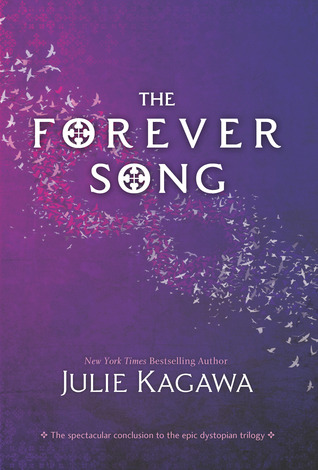
Review - The Forever Song by Julie Kagawa

The Forever Song (Blood of Eden, #3)

The Forever Song by Julie Kagawa
Series: Blood of Eden #3
Published by Harlequin Teen on April 15 2014
Genres: Young Adult, Paranormal, Dystopia
Pages: 393
Rating: 2/5 stars
Vengeance will be hers. 
Allison Sekemoto once struggled with the question: human or monster? With the death of her love, Zeke, she has her answer.
Monster. 
Allie will embrace her cold vampire side to hunt down and end Sarren, the psychopathic vampire who murdered Zeke. But the trail is bloody and long, and Sarren has left many surprises for Allie and her companions - her creator Kanin, and her blood brother, Jackal. The trail is leading straight to the one place they must protect at any cost - the last vampire-free zone on Earth, Eden. And Sarren has one final, brutal shock in store for Allie.  
In a ruined world where no life is sacred and former allies can turn on you in one heartbeat, Allie will face her darkest days. And if she succeeds, her triumph will be short-lived in the face of surviving forever alone. 
THE FINAL HUNT IS ON.
For the third and final book in a series in which the stakes are as high as they can possibly be, this book spends a lot of time on romance and not nearly enough on plot and action. The middle thirty percent of the book is literally just Allie and Zeke whining and arguing and kissing and whining some more. If I hadn’t already invested so much time and energy into this series, I would have DNF’ed it.

I might have enjoyed The Forever Song if Zeke was a stronger character. I might have liked it if I understood what made him so appealing to Allie. If I didn’t feel like he was holding her back. But that is not the case. I have disliked Zeke from his first appearance in The Immortal Rules, and my disapproval only increased in The Forever Song. Zeke is not the kind of love interest I want to see in a book about ruthless vampires who rule a dystopian society. He doesn’t fit in. His idealism is annoying instead of inspiring and I spent the first forty-odd percent of the book wishing he was dead. I think that this book would have been much stronger, particularly in Allie’s character development, if Zeke had in fact died at the end of The Eternity Cure. I would have loved to see Allie confront who she is as a vampire without Zeke around to guilt her into being a “good person”.

One of the biggest complaints I have about this series is the conflation of humanity and morality. Throughout the series, Allie rebels against what is expected of her as a vampire, believing their lack of humanity to make them inherently evil. This is something that I think Kagawa tries to resolve, but it didn’t work for me. I think that there is a distinct difference between humanity and morality, and I don’t think that line is painted as vividly as it should be in these books. It is not being a vampire that makes someone a bad person – morality is in the choices we make after the fact. Yes, there are a lot of horrible vampires out there, but I can’t say I’d have a lot of sympathy for the humans considering their immediate judgement of anything that is not like them. Not to mention the fact that humans have shown over and over and over that we are just as capable of atrocities as anyone else – humans do absolutely horrible things, but that does not throw their humanity into question. So why is it that humanity is something to hold on to at any costs?

I’m particularly disappointed in this book because of how much I loved The Immortal Rules and The Eternity Cure. There was so much potential for this book to be incredible, and it let me down at every turn. One bit of praise I can give it is that Kagawa writes great (though sometimes repetitive) battle scenes. She is quick with the action, and the pacing isn’t too bad if you forget about the middle section of the book.

My final complaint I have is the lack of female characters in the series. I didn’t really pick up on this until I was reading The Forever Song, but I can’t help but notice that Allison is the only woman in the entire series who actually matters. She is the only one with character development, the only one with agency and opinions and personality. The only other women to grace the pages of The Forever Song are Caleb and Bethany’s adoptive mother, who is suspicious and standoffish towards Allie and Zeke the moment she finds out that they are no longer human, and a human woman who Allie nearly kills at the beginning of the book, whose only purpose is to appear as a reminder to Allie of the relationship between herself and her deceased mother. I truly wish that some of the fascinating characters in these books could have been women. It just seems strange for there to be no other women in Allie’s life.

Best of Jackal (the one bright spot in this dismal book):
“Hey, maybe we can tie him half in and half out of the sun, that’s always interesting. Did that to some undead bastard who pissed me off several years back. The light began at his feet and crawled up towar his face, and it took a very long time for him to finally kick it. By the end, he was screaming at me to cut off his head.”

“Next time we get a flat, you’re on your own. In fact, I think some lazy little fucks who won’t be named need to learn the basics of changing a tire.” 
“For all I know, he could be chasing squirrels to make a necklace from their little squirrel balls.” 
“Puppy, I am getting so tired of listening to you whine about this. This isn’t rocket science. If you don’t want to be a monster, don’t be a bloody monster! Be an uptight stick in the mud like Kanin. Be a self-righteous bleeding heart like Allison. Or you can stop agonizing about it and be a fucking monster, it’s actually a lot of fun.” 
“All the meatsacks are perfectly content on their happy little island, Sarren has given up world destruction to raise kittens, and the magic wish fairy will wave her wand and turn shit into gold.

Thursday, 5 September 2013

Review - The Eternity Cure by Julie Kagawa


The Eternity Cure (Blood of Eden, #2)

The Eternity Cure by Julie Kagawa
Series: Blood of Eden #2
Published by Harlequin Teen on April 30 2013
Genres: Young Adult, Paranormal, Dystopian
Pages: 434
Rating: 4/5 stars
In Allison Sekemoto's world, there is one rule left: Blood calls to blood  
She has done the unthinkable: died so that she might continue to live. Cast out of Eden and separated from the boy she dared to love, Allie will follow the call of blood to save her creator, Kanin, from the psychotic vampire Sarren. But when the trail leads to Allie's birthplace in New Covington, what Allie finds there will change the world forever—and possibly end human and vampire existence. 
There's a new plague on the rise, a strain of the Red Lung virus that wiped out most of humanity generations ago—and this strain is deadly to humans and vampires alike. The only hope for a cure lies in the secrets Kanin carries, if Allie can get to him in time.
Allison thought that immortality was forever. But now, with eternity itself hanging in the balance, the lines between human and monster will blur even further, and Allie must face another choice she could never have imagined having to make.


Damn.

That was quite a book.

I’ve been meaning to sink my teeth into (haha, vampire jokes for a vampire book, aren’t I hilarious??) The Eternity Cure since it was first released, and I’ve been eagerly anticipating it since I read The Immortal Rules just over a year ago. It did not disappoint.

I’m just going to start off with a little tidbit that may inform whether or not you’ll find my review to your liking or not: I don’t like Zeke.

I’m not saying that I dislike him! I just find him a bit… tepid. He doesn’t really do anything for me. This may be partially due to his getting in the way of the badass vampiring I wanted to see Allison do in The Immortal Rules (though I suppose she wasn’t quite ready for that yet), but he just irritates me for some reason.

That said, it’s got to be a pretty good book for me to give it 4 stars when I don’t like the love interest!

Allie is one of my favourite YA protagonists. Lady gets shit done, and I appreciate that. She doesn’t take lip from anybody and she’s pretty deadly with a katana, which gets her bonus points.

If The Eternity Cure had just been the bantering adventures of Allie and Jackal, I would have been a happy camper. Er, reader. I had completely forgotten about Jackal’s role in The Immortal Rules until he was reintroduced early on, and I had to do a big “oooooh” when their relationship was recapped for me (Thanks for that, Julie Kagawa!). Jackal was bar-none my favourite thing in The Eternity Cure. I like smarmy, overconfident man-boys apparently. I think I like Jackal so much because it’s apparent to me that he isn’t to be taken seriously. He comes off as a total parody of all of the vampire clichés out there (Damon from TVD, anybody?). I mean, dude wears a duster.

I was pretty enraged by the end of the book. You know what I’m talking about, but I’m not enraged the way that most people are. I’m enraged because I was really looking forward to seeing Allie break her compassionate streak, and now I know that it won’t last. I really wish the last page or so of the epilogue hadn’t been included in this book. I would have preferred that information be revealed in book 3 (though really, who didn’t see it coming? This isn’t written by GRRM).


Friday, 23 August 2013

Review - Gameboard of the Gods by Richelle Mead


Gameboard of the Gods (Age of X, #1)

Gameboard of the Gods by Richelle Mead
Series: Age of X #1
Published by Dutton Adult on June 4 2013
Genres: Dystopian, Urban Fantasy
Pages: 448
Rating: 3/5 stars
In a futuristic world nearly destroyed by religious extremists, Justin March lives in exile after failing in his job as an investigator of religious groups and supernatural claims. But Justin is given a second chance when Mae Koskinen comes to bring him back to the Republic of United North America (RUNA). Raised in an aristocratic caste, Mae is now a member of the military’s most elite and terrifying tier, a soldier with enhanced reflexes and skills. 
When Justin and Mae are assigned to work together to solve a string of ritualistic murders, they soon realize that their discoveries have exposed them to terrible danger. As their investigation races forward, unknown enemies and powers greater than they can imagine are gathering in the shadows, ready to reclaim the world in which humans are merely game pieces on their board.


I went into Gameboard of the Gods completely blind. All I knew about the book was that it was the first in a new series by one of my favourite authors, Richelle Mead, and that it wasn’t a YA title.

I wasn’t thrilled by the first 45-50%. It was, to be honest, rather boring. I didn’t feel any emotional ties to the characters, with the exception of Tessa. I was particularly unimpressed with Justin. He was a shallow, self-involved tool. I’m writing this review a week and a half after reading the book and I actually forgot his name. Apparently that is precisely how much I liked reading about Justin. I found the mystery surrounding Justin with regards to the ravens in his head was… uninspired. I didn’t really care that much about what happened to him. I did think that the ravens, Horatio especially, were much-needed to Justin’s psyche. I was elated when Horatio called Justin out on being an asshole (on multiple occasions!), because he was saying exactly what I was thinking.

Mae was kind of bland to me. I found she didn’t really make much of an impression on me either way. In my notes I have written “emotionally stunted robot woman”, so clearly I wasn’t a big fan of Mae while reading, but she doesn’t enrage me like Justin does.

My biggest issue with Gameboard of the Gods is that it needed more character depth. I think that this is partly due to the use of third-person point of view, but I found the characters to be quite stereotypical.
The only character I really enjoyed reading about was Tessa, which is probably due to her being from the ‘provinces’. She read like more of a real person, and I loved reading about her immersion into this new and unfamiliar culture that was quite abrasive towards her.

Richelle Mead’s writing, while different tonally from all of her other books, is a pleasure to read. This book is written in a very cool, unemotional style that I believe was meant to cohere with the impersonal culture of the RUNA. It wasn’t my favourite Mead book by a long shot, but it was clear that the author was branching out and loving every minute of it. At only one point did the writing have any emotional draw to me – when Mead described the cultural isolation of Tessa’s first day of school in Vancouver. That scene was truly perfect, from the way that Melissa and the teachers spoke to Tessa like she was hard of hearing, made her repeat herself because they couldn’t decipher her accent, and generally acted as though she had never set foot in civilization before. Mead captured the feeling of other-ness as she described the “attitude and demeanor that screamed to the world that she hadn’t been born and raised in this glittering, frenetic society”.

The plot of Gameboard of the Gods really didn’t do much for me. Contrary to most of the complaints I’ve read about it, I think I would have been more satisfied if it had been focused more on politics and government workings and less on religious activities. It read more like a series of random scenes compiled in a semi-logical order than a finished product with a beginning, middle, and end. Well, it had a very distinct beginning, it was as it moved into the middle that everything became muddled.

As a final note, I really wish Porfirio had been a nicer dude, because he has the most badass name ever.

Friday, 26 July 2013

Review - Taken by Erin Bowman


Taken (Taken, #1)
Taken by Erin Bowman
Series: Taken #1
Published by HarperTeen on April 16 2013
Genres: Young Adult, Dystopian
Pages: 360
Rating: 1/5 stars
There are no men in Claysoot. There are boys—but every one of them vanishes at midnight on his eighteenth birthday. The ground shakes, the wind howls, a blinding light descends…and he’s gone. 
They call it the Heist. 
Gray Weathersby’s eighteenth birthday is mere months away, and he’s prepared to meet his fate–until he finds a strange note from his mother and starts to question everything he’s been raised to accept: the Council leaders and their obvious secrets. The Heist itself. And what lies beyond the Wall that surrounds Claysoot–a structure that no one can cross and survive. 
Climbing the Wall is suicide, but what comes after the Heist could be worse. Should he sit back and wait to be taken–or risk everything on the hope of the other side?


It’s hard to enjoy a book when the main character is as insufferable as Gray Weathersby. There is nothing to like about Gray because he isn’t a fully developed character – he’s a collection of traits typically belonging to ‘heroes’. He’s impulsive, suspicious, and easily angered. There is little else to say about him. Well, there is one other thing – he’s a huge hypocrite. Time and again he gets mad at people for doing things that he himself does without a moment’s hesitation. Early in the book Emma tells him that he is selfish, and I agree with her.

Oh, Emma. I wanted so badly to like her, and I feel like I sympathized with her more than any other character in Taken. That said, she’s just as underdeveloped as Gray. Her defining feature is that she’s gentle and good at stitching people up. I’m not kidding. That’s it. I actually really liked her when she was introduced; she was fiery and didn’t take Gray’s bullshit. That changed very quickly with the introduction of… drumroll please… INSTA-LOVE! Of course. I just can’t seem to escape it lately. I truly don’t understand what Emma liked about Gray. His attitude never changed, nor did his behaviour. It really felt more like Emma was trying to replace her friendship with Blaine with a relationship with Gray, despite the fact that the boys’ personalities couldn’t be more different. I’m just trying to find some reason for her to have attached herself to him so quickly, so I’m reaching here.


On the topic of girls, this book has one of the worst love triangles I have ever read. This is mostly because both girls are pretty decent people who deserve much better than whatever Gray could offer them. I was particularly upset by Gray’s decision (SPOILERS) after Emma cheated on him, thinking he was dead, to start something with Bree. I get that he was hurt, but SHE THOUGHT HE WAS DEAD. He thinks that he’s a better person than her because he didn’t act on his feelings for Bree while they were separated. However, Gray never thought that Emma was dead. It’s just not comparable.


I wish the characters had been more likeable, because the plot wasn’t that bad. It was predictable, and I found it very segmented, but I liked it. It was engaging enough for me to finish reading the book, which it gets credit for. But that’s really all there is to say about it. There were so many different elements to the plot that it felt as though Bowman was just throwing everything she could think of into this book. It wasn’t refined at all, and none of the plot twists and big reveals were very gratifying.


It just wasn’t much fun to read. I found myself bitching about it to myself and writing snippy little notes to myself making fun of it and poking plot holes (for instance, how do they explain the fact that a two year old child doesn’t look the same as a one year old, particularly a one year old who has supposedly been so ill as to disallow visitors for an entire year. Someone would have noticed that.).

Review - Feed by Mira Grant


Feed (Newsflesh Trilogy, #1)
Feed by Mira Grant
Series: Newsflesh Trilogy #1
Published by Orbit on May 1 2010
Genres: New Adult, Horror, Dystopian
Pages: 571 (906 minutes)
Rating: 4/5 stars

The year was 2014. We had cured cancer. We had beaten the common cold. But in doing so we created something new, something terrible that no one could stop. The infection spread, virus blocks taking over bodies and minds with one, unstoppable command: FEED. Now, twenty years after the Rising, bloggers Georgia and Shaun Mason are on the trail of the biggest story of their lives - the dark conspiracy behind the infected. The truth will get out, even if it kills them.
I tried to read Feed on four different occasions before finally sticking to it and seeing it to the end – apparently what I needed was a really great audiobook, narrated brilliantly by Paula Christenson and Jesse Bernstein, to truly get into it. That isn’t to say that I didn’t like it upon my other attempts. I did, I just got distracted somewhere along the way each time. This go around I listened to the fifteen hour audiobook in about two and a half days. I got into it this time, in a big way. There was nothing for me not to like – zombies, politics, and blogging all in one book? Count me in!

Despite some flaws, I really loved listening to Feed. It caught my attention and didn’t let go of it, and I quickly grew to love the characters for all of their strengths and their faults. They are what fictional characters should be – fully rounded people with all of the intricacies that are involved in being a human being.

I actually liked the weird, super-dependent relationship between Georgia and Shaun. It’s not something you see very often – it’s clear that their environment growing up led them to be distrustful of anyone who isn’t each other. I’d be pretty jaded if I had their parents, too.

Even the secondary characters were depicted as real people – I became quite attached to the likes of Steve, Rick, Buffy, and even Senator Ryman (I consider Shaun as much a main character as Georgia). The only character that I thought could have used work was Governor Tate. (SPOILER AHEAD) It was clear from the very beginning that he was the primary villain, and I would have liked a more interesting motivation that religious fanaticism. I get that it’s completely possible and even perhaps likely, but it’s nothing new – it’s a stale bit as far as zombie fiction goes.

This is the way that I like my zombies – enmeshed in the atmosphere and part of the background. They pose an element of risk and influence the events of the story, but they themselves are not the focus. It’s not about the zombies – it’s about the people. I’ve had a lot of exposure to zombie stories – I took an entire class revolving around them – and this is one of my favourites. It isn’t as misogynistic as some of its contemporaries (I’m looking at you, The Walking Dead), though it certainly isn’t without its own issues in that area – most notably the treatment of Senator Ryman’s female opponent, whose recent acquisition of a new, enlarged pair of breasts is mentioned and derided repeatedly by Georgia. It is obvious that no one takes her seriously as competition to Senator Ryman. There is also a statement that Tate makes about Georgia, though it’s different when it’s explicitly a character being malicious, not woven into the narrative.

The end of the book, as many other reviewers have stated, is absolutely heartbreaking. I’m not ashamed to admit that I cried on multiple occasions.