Showing posts with label sci-fi. Show all posts

Thursday, 11 September 2014

Bookish Spotlight - Space!

Today's post was inspired by the fact that I recently read and was subsequently disappointed with These Broken Stars, which I wanted so badly to like. I mean, it's set in SPACE. How can that possibly go wrong? Unfortunately, it really did in this case, which led me to this post. Today I'm going to shine a virtual spotlight on a few other space books that are worth reading!


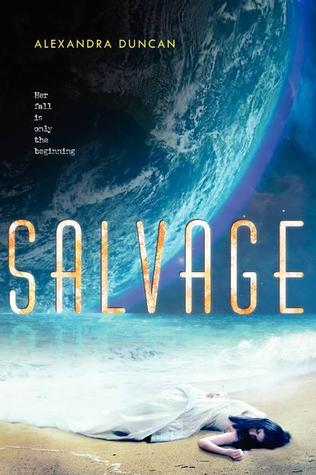
Salvage

Salvage by Alexandra Duncan

I will be the first person to admit that the beginning of this book is quite the slog. It was not fun to read, but once it gets going it REALLY gets going. 

The first few chapters are dedicated to acquainting the reader with the society on the Parastrata, the spaceship on which main character Ava was born and raised. It is really confusing and the way that the characters speak is frustrating to say the least. Their dialect is strange and takes some getting used to. 
It gets really awesome when Ava returns to Earth and experiences some serious culture shock. This book isn't as action packed as most space books as it's more of a character driven story, but it's well worth reading. It's one of my favourite space reads.


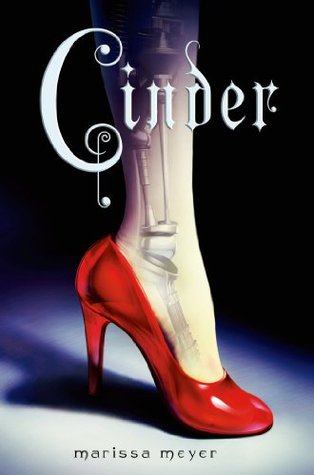
Cinder (The Lunar Chronicles, #1)

Cinder by Marissa Meyer

Okay, so we don't actually get to experience much of space until Cress, but you have to read Cinder (and Scarlet) to get there! I mean, you could pick up Cress first if you really want to, but it might not make that much sense. 

A large chunk of Cress takes place on a remote satellite where Cress is kept prisoner. Some bits also occur on various spaceships, and on the moon. Yeah, moon colonies. It's fantastic. This one is a little more fantasy and a little less hard sci-fi, but I'm hella okay with that. Heavy science fiction makes my head hurt sometimes.


Aaaand there are a few other YA books set in space, like Across the Universe, Avalon, Inside Out, and Starglass, but I have yet to read any of those!
Across the Universe (Across the Universe, #1)Avalon (Avalon, #1)
Inside Out (Insider, #1)Starglass (Starglass, #1)
Have you read either of these books? What about the ones I haven't checked out? Would you recommend any of them in particular? What are your favourite space books?

Monday, 8 September 2014

Review - These Broken Stars by Amie Kaufman & Meagan Spooner


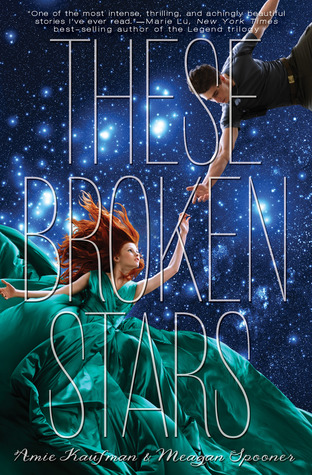
These Broken Stars (Starbound, #1)

These Broken Stars by Amie Kaufman & Meagan Spooner
Series: Starbound #1
Published by Disney Hyperion on December 10 2013
Genres: Science Fiction, Young Adult, Space
Pages: 374
Rating: 2/5 stars
It's a night like any other on board the Icarus. Then, catastrophe strikes: the massive luxury spaceliner is yanked out of hyperspace and plummets into the nearest planet. Lilac LaRoux and Tarver Merendsen survive. And they seem to be alone.  
Lilac is the daughter of the richest man in the universe. Tarver comes from nothing, a young war hero who learned long ago that girls like Lilac are more trouble than they’re worth. But with only each other to rely on, Lilac and Tarver must work together, making a tortuous journey across the eerie, deserted terrain to seek help.  
Then, against all odds, Lilac and Tarver find a strange blessing in the tragedy that has thrown them into each other’s arms. Without the hope of a future together in their own world, they begin to wonder—would they be better off staying here forever? 
Everything changes when they uncover the truth behind the chilling whispers that haunt their every step. Lilac and Tarver may find a way off this planet. But they won’t be the same people who landed on it.
These Broken Stars tells the story of privileged teenager Lilac LaRoux and lower-class soldier Tarver Merendsen, who are essentially shipwrecked on an isolated planet with no means of communication and no other survivors. It isn’t the most exciting premise and doesn’t offer a particularly insightful look into class politics, but I’ll admit that I really didn’t expect it to.

When Tarver meets Lilac, he is drawn to her because he glimpses her in a moment when she is not acting like the society dame she is expected to be. They have a short and unmemorable conversation before parting ways, and when they meet again Lilac is with her friends and realizes that she needs to more of less “put Tarver in his place”. Not because she wants to, of course, but because she’s protecting him. Duh.
Erlich Smack
What I wanted to do to Lilac
I was put off by both of the main characters from the very beginning of the story. Tarver is judgemental and obtuse while Lilac has been completely brainwashed by her status. She lies and manipulates people and then tries to excuse it because she’s protecting them. It’s ridiculous. The only useful skill Lilac has is an extensive knowledge of electrical circuitry, which saves her and Tarver from burning up with their spaceship, the Icarus (because it’s SUCH a great idea to name your spaceship after a figure of Greek mythology who succumbs to his own hubris).

Things improved in the characterisation department after the crash, but I still found myself agitated by the characters. Lilac in particular really grows throughout their journey, but there is a major event at the end of the book that absolutely ruined everything good this book had going for it. I just couldn’t take it seriously anymore and I honestly felt kind of betrayed. I stopped caring about what happened altogether. I found Tarver kind of irritating if only because he read as completely unrealistic. He never really had any flaws and I’m not down with that.

I was also unimpressed by the resolution to the “mystery” behind the spectral voices and visions plaguing Lilac and Tarver after the crash. I think that’s just a matter of personal preference, but I just didn’t like it. The world-building was also lackluster in that it was more or less non-existent. I know literally nothing about the society Kaufman and Spooner apparently created. I also thought the password for the locked door that they couldn’t figure out for days and days was ABSOLUTELY RIDICULOUS. It was pretty damn obvious.
 Bang My Head
The writing was pretty solid – I thought there were some beautiful passages and I didn’t find anything glaringly awful. However, I will say that I wish there was more of a masculine edge to Tarver’s narrative. His voice was very similar to Lilac’s as far as language goes.


I highly doubt I’ll be picking up the next book in this series, but who knows. I’m nothing if not a glutton for punishment. At least it wasn’t as bad as Taken!

Monday, 7 July 2014

Novella Review - Natural Selection by Malinda Lo


Natural Selection (Adaptation, #1.5)

Natural Selection by Malinda Lo
Series: Adaptation #1.5
Published by Little, Brown Books for Young Readers on September 3 2013
Genres: Science Fiction, Young Adult, Novella, LGBT
Pages: 80
Rating: 3/5 stars
I was born on Earth, not Kurra. I'm not human,even though I try to be. My people, the Imria, think I'm a little unusual because of that. They call me an Earthsider: as if I've crossed a line, chosen a side. Gone native.  
Before she met her girlfriend Reese, before she knew the role she would play in the fate of two worlds, Amber was a fifteen-year-old Imrian torn between two identities. Imrian by blood, Amber was forced to hide her true self to pass as human during the time she spent on earth. And even when she returns to Kurra, her human experiences, including first love and heartache, still separate her from her fellow Imrians. But when Amber undergoes kibila, a traditional Imrian coming-of-age ceremony during which Amber will choose her name and identity for the next fifteen years, she will be forced to either accept her role in both worlds or forge her own path.
Novellas aren’t really my thing. I find they tend not to add anything of importance to the overall story, and I usually feel like they’re kind of a waste of time. That said, this is an example of everything novellas should be.

Natural Selection takes place a few years before the events of Adaptation, and follows my favourite character Amber through two very important events in her adolescent life – a middle school camping trip on Earth and a coming-of-age ritual on Kurra. The chapters alternate between both parts of Amber’s life and tell the story of how she chose the name Amber. I loved the integration of Amber’s human and Imrian identities. As an Imrian born and primarily raised on Earth, there is a constant conflict with Amber’s struggle to fit in, something she is incapable of in both settings. On Earth she is forced to contain herself, has to learn to keep out of the emotions of the people around her. She isn’t allowed to be who she really is, but she also stands out from her Imrian peers. Amber’s storyline on Earth really hit home for me, though I’ve never really experienced anything quite like that. I could definitely relate to the inevitable best friend crush every queer girl experiences. They suck, and Amber’s is particularly rough. It made me really feel for her and the difficulty of having to navigate two completely different societies with different sets of acceptable behaviours.


The Adaptation series is one I think about on a regular basis. It lingers in my mind and is one of the most memorable series I’ve ever read. I loved returning to this universe and learning more about Amber, whose perspective and history we really don’t learn much of in Reese’s books. It was a quick read that was just what I was in the mood for, and it perfectly struck the balance that novellas have to straddle between adding new and important information without being integral to the plot of the primary novels in the series. I’m definitely glad to have read this, if only to extend one of my favourite series. The fact that I’ve been kind of in love with Amber since Adaptation certainly doesn’t hurt it either. I'd definitely recommend it to anyone who was craving a bit more from the Adaptation universe.

Monday, 26 May 2014

Review - Salvage by Alexandra Duncan


Salvage

Salvage by Alexandra Duncan
Series: Standalone
Published by Greenwillow on April 1 2014
Genres: young adult, sci-fi
Pages: 520
Rating: 3.5/5 stars


Ava, a teenage girl living aboard the male-dominated deep space merchant ship Parastrata, faces betrayal, banishment, and death. Taking her fate into her own hands, she flees to the Gyre, a floating continent of garbage and scrap in the Pacific Ocean, in this thrilling, surprising, and thought-provoking debut novel that will appeal to fans of Across the Universe, by Beth Revis, and The Handmaid's Tale, by Margaret Atwood.


Salvage took me by surprise. I hated the beginning of this book. It was infuriating – the strange jargon, the incredibly misogynistic society of Ava’s ship, the lack of connection to Ava. I was so close to putting this book down on many occasions over the first few chapters. However, when I consulted goodreads, quite a few of my friends, whose opinions I trust, had given this book four or five star ratings, claiming that it was a great feminist read and that Ava was an inspiring, fascinating character. Thus, I pressed on. I didn’t really want to and I hated every minute of it (until a certain point), but I kept reading. It was so worth it.

The story doesn’t truly begin until Ava flees her home ship, the Parastrata, and goes down to Earth. This is where things got really interesting. Earth in this book is far from what I expected from what the goodreads description tells me. I was expecting something bizarre and completely different from what is familiar to me – and in some ways, that is what I got. But it was unfamiliar not because the face of the earth was hugely changed but because it took me to parts of the world I have never seen. I absolutely loved that about this book. YAY FOR ETHNIC DIVERSITY.

Not a single scene takes place in an English speaking country. The first city Ava visits is the impoverished Gyre, home to my two favourite characters Perpetue and Miyole. She later goes to Mumbai to find an aunt whom she has never met, the only family she has left. Ava is exposed to cultures that are vastly different from her own, and it takes a long time for her to adjust.

As much as I hated it at times, I really appreciated how difficult it was for Ava to discard her Parastrata beliefs and the values she was brought up to have. She doesn’t become a completely different person the moment she goes “planetside”. She struggles with fitting in and clings to some aspects of her old life, in particular a boy, Luck. Ava’s obsession with Luck didn’t really make a lot of sense to me – they hardly knew each other, had interacted maybe four or five times total, but I also understood that Ava’s ‘love’ for Luck was born of growing up with incredibly minimal contact with men, and basically none with men outside of her own family. She romanticized Luck because he was ripped away from her and because he was the one person from her old life who never treated her poorly. She couldn’t reflect on her family without thinking about the awful way they treated her – they tried to kill her. In that sense, I think that Ava’s preoccupation with Luck was quite fascinating. It didn’t make me like it, though. It was annoying.

There wasn’t much action in this book. It was very character driven, which is something that I happen to love. I can see how it wouldn’t be to everyone’s tastes. It’s long and at times it drags. It is perhaps a little bit too descriptive, but it is unlike anything else I’ve ever read. It is a truly singular book and I’m looking forward to what Alexandra Duncan comes out with next.

Wednesday, 14 May 2014

Review - Origin by Jessica Khoury


Origin (Origin #1)

Origin by Jessica Khoury
Series: Origin #1
Published by Razorbill on September 4 2012
Genres: Young Adult, Science Fiction
Pages: 394
Rating: 0/5 stars (DNF)

Pia has grown up in a secret laboratory hidden deep in the Amazon rain forest. She was raised by a team of scientists who have created her to be the start of a new immortal race. But on the night of her seventeenth birthday, Pia discovers a hole in the electric fence that surrounds her sterile home―and sneaks outside the compound for the first time in her life.
Free in the jungle, Pia meets Eio, a boy from a nearby village. Together, they embark on a race against time to discover the truth about Pia's origin―a truth with deadly consequences that will change their lives forever. 
Origin is a beautifully told, shocking new way to look at an age-old desire: to live forever, no matter the cost. 


I was only able to read 124 pages (31%) of this book before I had to call it quits. In the first hundred pages alone, there’s animal torture, racism, and sexism, the problematic elements of which are completely ignored within the narrative. To be completely honest, I’m kind of disgusted.


But no, I actually think racism is worse than animal cruelty in many ways. I’ve actually taken classes on both (taught by the same professor, strangely). I have a low tolerance for either, and even though sexism is abundant in fiction, even in YA where there is a much higher percentage of female authors and main characters, I have very little patience for it.

The real downer in this book, if you can get past some of the infuriating content (which I couldn’t), is the main character. Pia is a little snot. She is incredibly self-obsessed, which makes sense considering her upbringing but doesn’t make her any more sympathetic or relatable. She’s a pompous jerk who has been told since birth that she’s “perfect,” and she wholeheartedly believes it. She has also been shut off from pretty much everything in the world – she has been sequestered in a compound all her life among scientists who are forbidden to discuss the world beyond their enclosure. This leads to another frustration that I had with the book: Pia reacts to new things and people and experiences not with wonder and curiosity but with scrutiny and judgement. She believes herself to be better than everyone and parrots the colonialist attitudes of her “aunts and uncles” (the scientists who have raised her).

The few merits this book has (which I honestly can’t even place at the moment) are greatly outweighed by the myriad ways it offends and irritates me in turn. I had planned on reading at least half in order to form an informed opinion, but I fear that it will just go downhill from here. I don’t care to waste my time on books I don’t enjoy.


I’d also like to note that while the book has many racist themes, that doesn’t necessarily mean that I think Jessica Khoury is a racist. I don’t want to get into a whole discussion on racist as an identity versus racist acts and words, but I just want to make sure nobody thinks that I’m targeting Khoury. I’m sure she’s a wonderful person, but she has written a book that, in my opinion, is a testament to colonialist ideals and racism.

Have you read Origin? Any of Khoury's other books? Tell me what you thought in the comments.
Monday, 23 September 2013

Review - Cinder by Marissa Meyer


Cinder (Lunar Chronicles, #1)

Cinder by Marissa Meyer
Series: Lunar Chronicles #1
Published by Macmillan Young Listeners
Genres: Young Adult, Sci-Fi, Retellings
Pages: NA (Audiobook)
Rating: 4/5 stars

Humans and androids crowd the raucous streets of New Beijing. A deadly plague ravages the population. From space, a ruthless lunar people watch, waiting to make their move. No one knows that Earth’s fate hinges on one girl. 
Cinder, a gifted mechanic, is a cyborg. She’s a second-class citizen with a mysterious past, reviled by her stepmother and blamed for her stepsister’s illness. But when her life becomes intertwined with the handsome Prince Kai’s, she suddenly finds herself at the center of an intergalactic struggle, and a forbidden attraction. Caught between duty and freedom, loyalty and betrayal, she must uncover secrets about her past in order to protect her world’s future.


I am so excited to get my hands on the next book in this series. I can't even handle it. There were some things that I wasn't so keen on, but on the whole it was a fantastic book. I can definitely see why it was so hyped up!

The characters in Cinder were excellent. The eponymous character is one of the best protagonists I’ve ever read, simply because she is so different and unexpected. I mean, the girl is a futuristic cyborg. There is so much room for error there, but Meyer managed to pull it off beautifully. I thought that Cinder’s struggles with her identity and finding her place in society were very well-portrayed, and her relationships with the other characters (particularly Iko and Peony) were brilliant. I love reading about friendship in YA novels, mostly because it so often gets sidelined in favour of romantic relationships. But friends are so important, and it’s something (I think) that more people can really relate to. I also loved the sense of sisterhood between Cinder and Peony, and the contrast between Cinder’s relationship with Peony and that with Pearl. There was one scene that really broke my heart; when Pearl accused Cinder of never really caring about Peony and suggested that she had in fact killed her. It was just made worse when she added that Peony was never Cinder’s sister and that Cinder must be incapable of loving her the way that she and Adri did.

I was less fond of Cinder and Prince Kai’s relationship. I liked it, but it didn’t feel as strong to me as that of the women (and android!) in the novel. I thought Prince Kai was a decent enough love interest, but I was annoyed at how long it took for him to find out Cinder’s secrets (and the fact that she didn’t just tell him in the first place…).

The plot of Cinder wasn't quite as good as I'd have liked it to be. It was an interesting take on the Cinderella story and I liked the extra things that Meyer added (cyborgs, androids, a moon colony of people with psychic powers). I found that I had a lot of issues with decisions Cinder made throughout the novel, particularly when it came to withholding information. The twist regarding Cinder and the Lunar Queen was pretty freaking obvious. I kind of felt like hitting Cinder upside the head and forcing her to put 2 and 2 together, for god’s sake!